HIT-CAT
Project funded by MICIU/AEI- PID2020-119242-I00 and led by Verónica Salgueiriño (jointly with Begoña Puértolas Lacambra from TNT group at CINBIO).
The project HIT-CAT
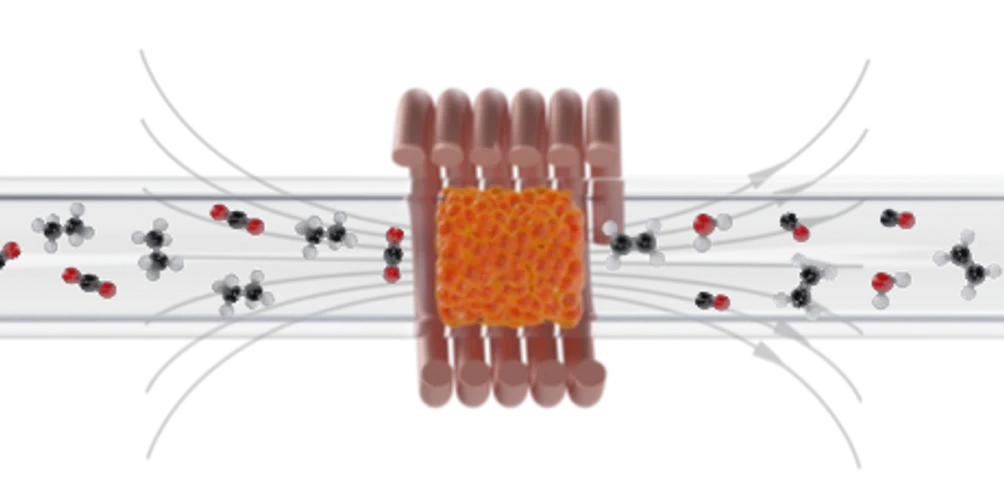
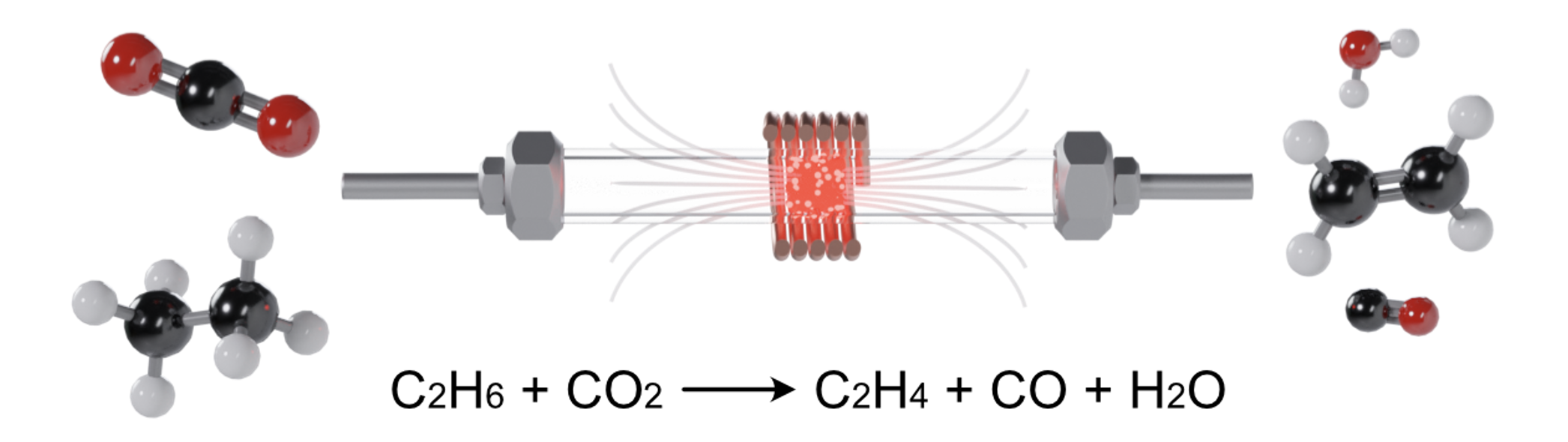
This project targets the development of sustainable catalytic technologies for the CO2-mediated oxidative dehydrogenation of ethane and propane to olefins using localized heat generated from magnetic nanoparticles subjected to an alternating magnetic field.
.
Objectives
The synthesis and characterization of spherical or polyhedral mixed metal oxide- and core-shell-type magnetic nanoparticles with optimal temperature control (by a finely tuned magnetically induced heat delivery and controlled heat transfer) and performance in the gas-phase oxidative dehydrogenation of ethane and propane with CO2 (Leader: Verónica Salgueiriño).
The synthesis and characterization of magnetic nanoparticles supported on different carriers as efficient catalysts for the CO2-mediated oxidative dehydrogenation of light alkanes using the localized heat generated from the nanoparticles (Leader: Begoña Puértolas)
Strategy
This project entails four consecutive parts for the development of optimal catalytic systems for the magnetically-induced oxidative dehydrogenation of light alkanes to olefins with CO2 during a period of 36 months. The first part (A) deals with the synthesis and basic characterization of nanostructured catalysts with magnetic properties and heat delivery ability. The second part (B) focuses on the catalytic evaluation of the materials in the CO2-ODH of light alkanes in a gas-phase continuous flow fix-bed reactor. The third part (C) is dedicated to the advanced characterization of the leading candidates and the fourth part (D) to the mechanistic and kinetic studies, taking into account that the fundamental understanding of the catalysts is central to this study. Accordingly, Part A encompasses the preparation of a library of materials based on
supported metal catalysts,
nanoparticles of mixed metal oxides, and
(iii)
core-shell structures of metal oxides, by which the controlled syntheses to obtain certain sizes, shapes, and the core-shell morphology will create new functionalities to enhance the catalytic performance.
All materials will be tested in both the oxidative dehydrogenation of ethane and propane in a gas-phase continuous flow fixed-bed reactor set up for catalytic evaluation (Part B). Once promising leads are identified (Milestone 1, M1, M2), in-depth characterization (Part C), computational, and
mechanistic and kinetic studies (Part D) will be performed on these catalysts and on selected materials to improve fundamental understanding of the reaction mechanisms and to derive synthesis-structure-performance relationships for each catalyst family (M3, M4). The results obtained will enable the identification of the key descriptors of the catalytic properties of the solids, thus facilitating the rational design of optimized materials.
Some publications
Tuneable Magnetic Remanence of Antiferromagnetically coupled Fe3O4@SiO2 nanoparticles for in vivo Biomedical Applications
Tiryaki, Salgueiriño et al. ACS App. Nanomaterials, 2025 (in press).
Organic Molecular Glues to design Three-Dimensional Cubic Nano-assemblies of Magnetic Nanoparticles
Román-Freijeiro, Salgueiriño et al. Chemistry of Materials, 2024, 36, 6865-6876.
Magnetically induced Thermal Effects on Tobacco Mosaic Virus-based Nanocomposites for a Programmed Disassembly of Protein Cages
Tiryaki, Majcherkiewicz, Salgueiriño et al. ACS Appl. Bio Materials 2024, 7 (2024), 4804-4814.
Room-Temperature Spin-Phonon Coupling in Cr2O3 Nanocrystals
Majcherkiewicz, Salgueiriño et al. Adv. Funct. Materials 2023, 2301973.
